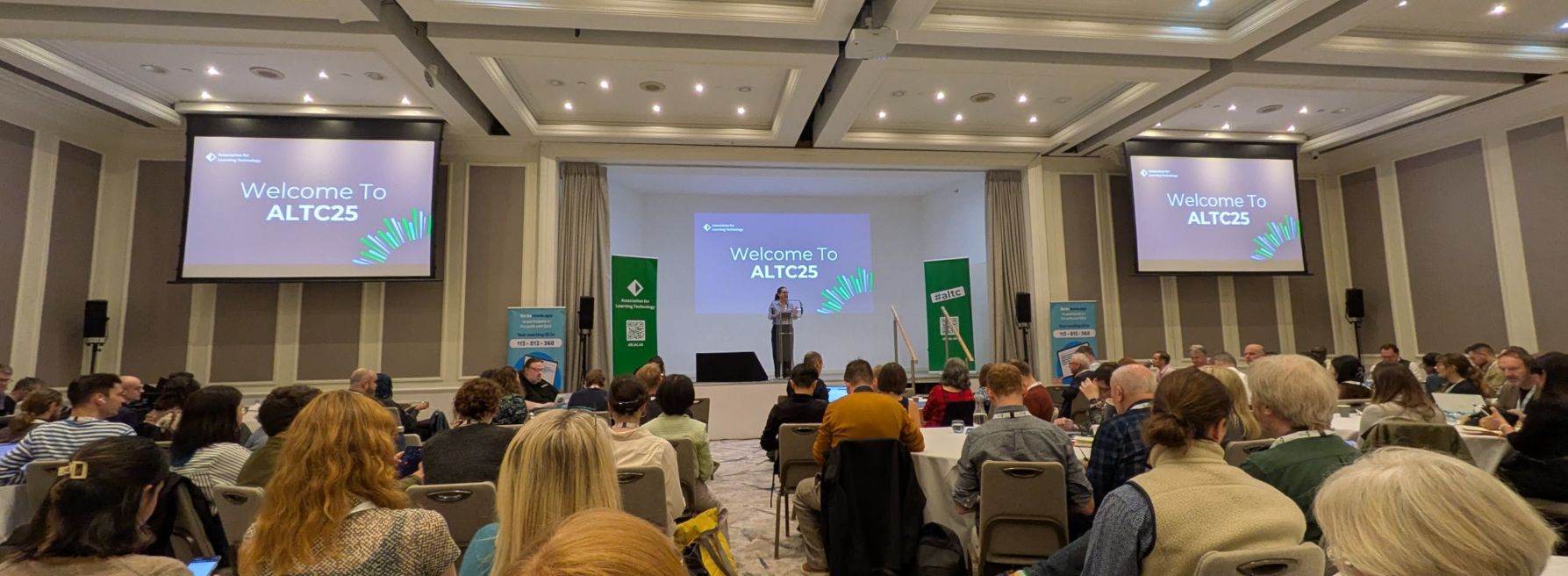
I’ve seen a shift in how our community of professionals working in educational technology, learning design and educational leadership has become more attuned in its use of contemporary pedagogy and student-focused practice. There’s a maturity of thought, informed by both established and emerging theory, and design methodology, that is complemented with a renewed enthusiasm for addressing the (many) challenges facing the tertiary education sector. The Association for Learning Technology Annual Conference which took place 23-24 October 2025 in Glasgow tapped right into the values and motivations of professionals working in education, who thrive on working collaboratively, sharing and understanding with others, and finding ways forward in different educational settings to enable learning to happen. This is the second post reflecting on my learning and thoughts inspired by conference speakers (see previous post).
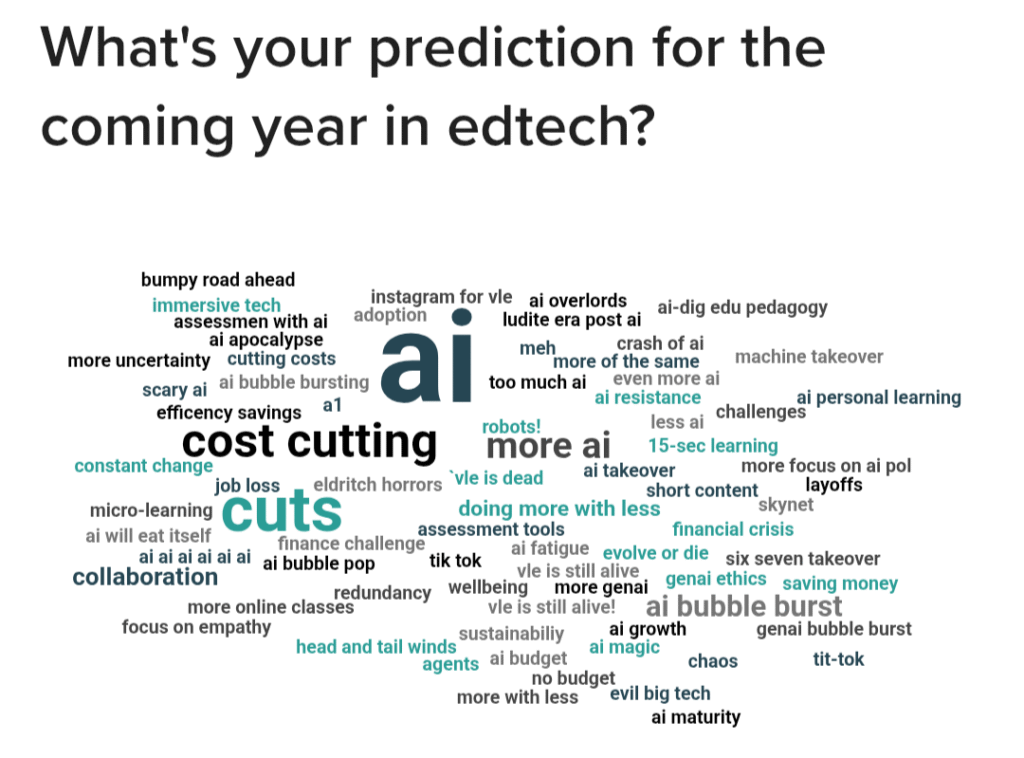
As a bit of framing, the response to the poll question asking for predictions about educational technology in the year ahead is telling. The dominating piece of tech is AI, with ‘the VLE’ relegated to a sector in-joke ‘the VLE’ is dead… the VLE is alive!’. The tone about AI is on the cusp of exhaustion (‘meh’ was the highest frequency word in an AI-related poll), with concern about ‘AI bubble burst’. From the learning design angle, there was a hint of opportunity with ‘AI personalised learning’ and an attempt at meeting learners where they are on ‘tiktok’ with ‘15 second learning’ and ‘microlearning’. Though, for me, that is miles away from deep and meaningful learning we aspire to. The overriding theme is concern about ‘funding’, ‘cost cutting’ and job insecurity. It’s this interplay of themes which I think fully justifies why this conference and its community exists. Our profession brings criticality to shifting agendas in education, as we try to cut through the hyperbole and draw upon experience, evidence and expertise to co-create education that enables students to succeed.
Grounding our work
Day 2 opened with Gabi Witthaus and her keynote that brought together so many themes to resonate with everyone in the room. It exemplified how learning and the educational experience is tied to individuals and their context, with place, technology, structures and barriers that demand empathy, care and creativity for success. I am a fan of clear frameworks and Witthaus’s combination of a well-established engagement framework (Redmond, et al., 2018) with a contemporary lens of ‘capabilities’ will be incredibly useful to practitioners in both design, teaching and evaluation. The online engagement model has been discussed previously at ALT, where Bergdahl (2022) evidenced a lack of attention to social and emotional engagement in educational practice, which Witthaus wonderfully echoed with the results of the poll responded to by the keynote audience.
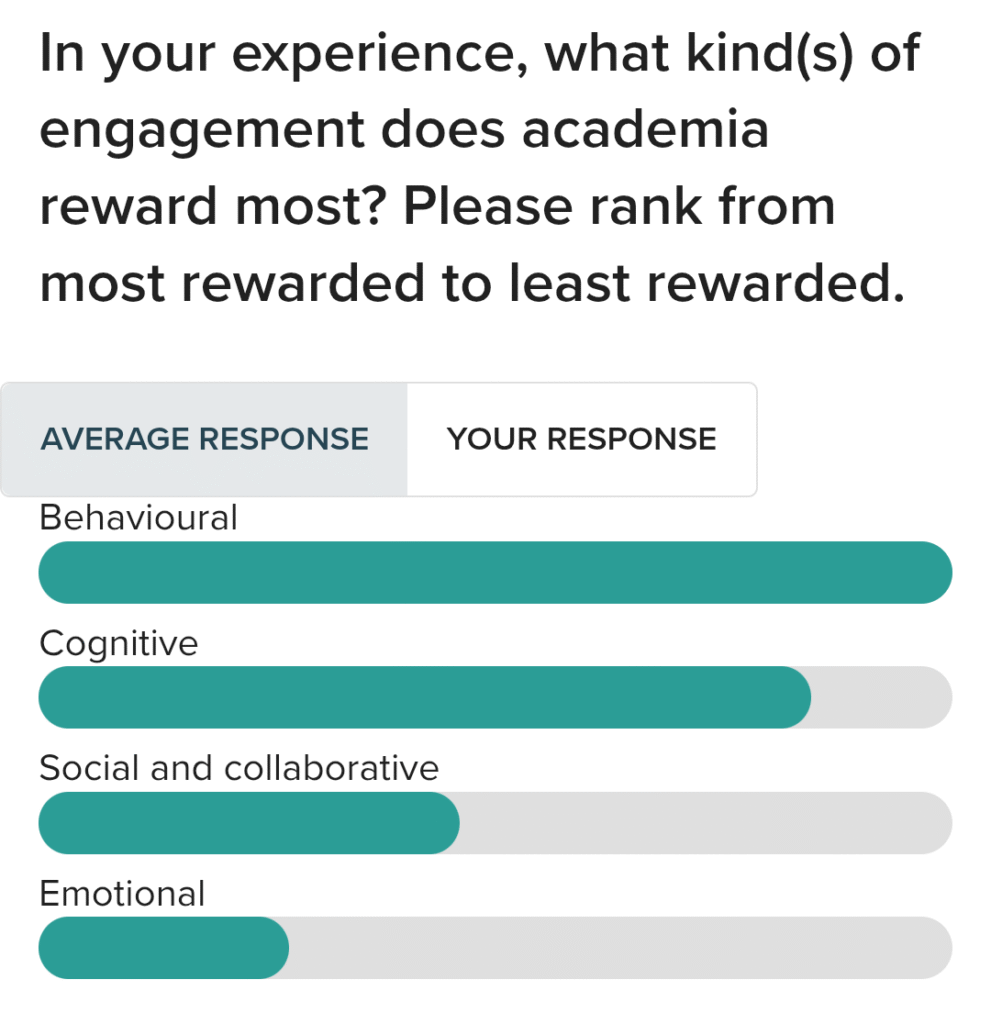
With the question phrased in terms of which type of engagement is most ‘rewarded’ by academia, ‘behavioural’ and ‘cognitive’ far out ranked ‘social and collaborative’ and ‘emotional’. However, particularly in social learning pedagogy, social constructivism or connectivism, which underpin a fair amount of online education, we need to design for engagement across all areas of learning.
“If you engage socially and emotionally, you’ll engage cognitively and behaviourally.”
Witthaus (2025)
Witthaus explored how engagement is not just a construct of the educational design, but interconnected with the context of the learner. Therefore there are capabilities needed to engage and, from a learner point of view, to be engaged. The definitions of capabilities (referencing Martha Nussbaum, Melanie Walker and Amartya Sen) as both personal skills and abilities with the freedoms from a social, political, economic context to enact them was such a powerful concept, especially when considering international students. This idea was pointedly explored by Witthaus with vignettes from students who were breaking curfews in order to access the internet, studying in train stations as the only shelter available, or displaying extraordinary levels of resilience to study through war and trauma. The positive message from this is the power of online education to reach and enable learners who would otherwise not have the opportunity available to them. The practical message is that we need to be conscious of these contexts and ensure educational systems accommodate them.
Understanding educational contexts
The point about capabilities being linked to context resonated with a contribution earlier in the conference in my own workshop, from a delegate who shared their experience as an international student. When they returned to their home country, although they were a graduate, they were told by their employer that their knowledge and skills developed over three years didn’t apply to their local context. This example shows a complex relationship of the value of multiple perspectives, international learning and local application. In the online education space, these relationships play out in real time, and capabilities may be dependent on more serious contexts, such as the example shared by Witthaus where a student was conscious of the potential of her outputs of study to offend others (for example where a strong belief system impacts free speech) or endanger herself. Other quotes suggested students having to overcome significant imposter syndrome comparing their own life with that of others shared in group discussion forums. An unexpected echo of toxic social media that undermines students’ individual achievements. The complexity of humans interacting, remotely and all around the world, both synchronously and more often asynchronously, demonstrates unequivocally why specialists in supporting online students are critical in educational institutions.
In contrast to the first day’s keynote that was motivational through its energy and enthusiasm for what we can achieve as a collective, this keynote really grounded our practice in reality, showing the impact that education can have on real individuals. Work such as this is a strong values-led motivation for all those working in education, whether as an academic, researcher or educator, or in professional services throughout the learning journey. I can’t do all the detail justice, so have selected text from one of the slides and copied below as a prompt for further review and a recommendation to read Witthaus’s (2023) research paper.
“To support knowledge and imagination
1. Find the kindest balance between flexibility and structure;
2. Embed ‘warm support’ in the learning design;
3. Build accountable spaces for and with students.”
(Witthaus, 2025)
Design for a better education
A prevalent theme in sessions involving online learning design was the process of pedagogically driven design being ‘good’ for any mode of learning. Indeed, this theme came up in Witthaus’s keynote (quoted below); as an opportunity, suggested by delegates in Paul Bacsich’s workshop to address funding issues, by designing once and repurposing for different educational experiences; and transferring the design practices common to online education into design practices for campus-based programmes. It’s the structured design process or clear design framework, for example ABC (Young and Perović, 2016), Carpe Diem (Salmon, 2013) or the application and adaptation of the Jisc ‘Beyond Blended’ six pillars (Beetham and MacNeill, 2023) by John Brindle and Edge Hill University, that enables academic subject matter, pedagogy and learning contexts to come together. The choice of frameworks and approaches are also evolving and becoming more sophisticated in their underlying principles, bringing ideas of critical thinking and educational neuroscience into design decisions, inclusivity and empathy, designing for creativity (Molloy, et al., 2025) and designing with pedagogies of care and well-being (Baig, 2025). Brindle’s example also shows a clear understanding of where frameworks just don’t fit, identifying the limitations of the ABC framework that become cumbersome when applied to spiral curricula within vocational subjects such as medicine (Brindle, 2025).
“Online learning design tends to be good learning design for all modes of learning. Designing for inclusion of the most challenged learners tends to be good learning design for all learning.”
Witthaus (2025)
Across the breakout sessions I attended, it was the more conscious approaches of designing for learning experience, rather than just an implementation of technology, that has showed how our professional sector has developed over the years. There are still occasions when well-established theory is presented as a novel approach, but this reflects how our community is formed by those who are both fully immersed in a range of theories, and those who are discovering great ideas for the first time. Even when familiar, established research is resurfaced, it’s also reframed and reshaped by new educational contexts and ideas. Educational neuroscience has provided a more scientific evidence base for theories of the past, including debunking myths and enabling positive narratives around brain plasticity and physiological explanations for emotional engagement for learning. In fact, the angle of pedagogies of care and well-being are offering new lenses to interpret theories of old, by focusing much more on individuals in the learning process and critically updating for inclusivity and modern responsibilities of educational institutions.
What I have really enjoyed though is how design methodology includes practices that require a deep understanding of the end user (learner), the context they are in and an iterative approach to adapt to feedback. Human-centred design approaches are therefore key to effective use of learning technology. This ‘interplay between learning and technology’ is a core principle of the CMALT scheme, and through the short presentations and breakout sessions it’s clear how this principle is being evidenced and embedded in professional practice. Perhaps we should be talking as much about ‘affective’ use as ‘effective’ use. More and more this ‘interplay’ has a more explicit third component which is the humans involved in the learning process and technological systems.
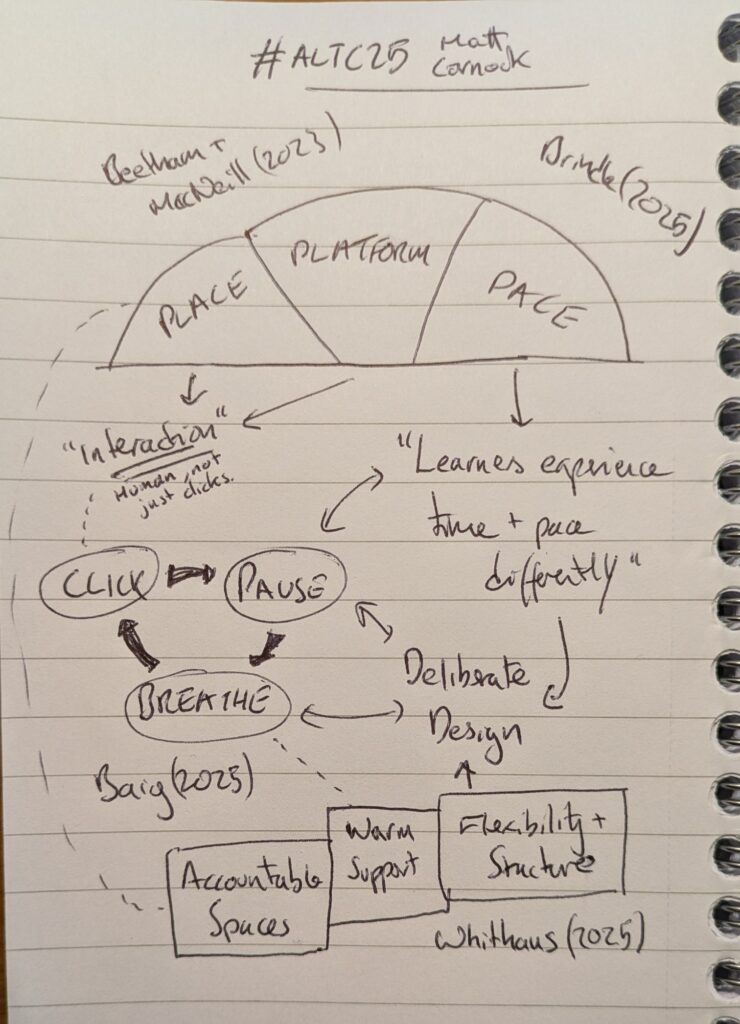
Baig’s (2025) short paper as an example of the above, presented an activity design approach that emphasised control of pace of learning and moments for reflection. Whilst I would prefer to use ‘interaction’ as more encompassing online/offline, individual/social activities, the ‘click’ part of the digital/online learning experience is framed with deliberate ‘breathe’ and ‘pause’ moments. This is where I saw links across ideas from both Witthaus and the ‘Beyond Blended’ work of Beetham and MacNeill (2023) cited by Brindle. I’ve captured this as a hand-drawn diagram (below), but in essence the main linking principle is the idea of a designed experience.
Professionalism of learning technology
The final points I want to share come from a selection of presentations. Each point further demonstrates how I think we have a community that is really demonstrating its significant contribution to education and our role in collaboration with educators and other services in institutions.
- “A living ecosystem” pushing forward inclusivity through recognition of the complexity of human organisational systems in institutions. Learning technology practitioners leading communities to give voice to both students and staff otherwise underrepresented. (Chapman and Ward, 2025).
- The role of learning technologists to make connections across educators, providing space to share practice and channel good practice. For example, where experienced industry professionals become academics, learning technologists and learning designers help by identifying appropriate teaching and learning techniques for the discipline. (Thomson, 2025).
- Enabling academics to rethink activities and adapting to student feedback, but with recognition of both intentional learning challenges and manageable expectations. For example, valuing the intention behind creating a student-generated Open Educational Resource (OER) in the form of a multimedia rich textbook, setting the expectations that it will not be without fault, but also addressing motivation issues by reducing the size, designing for peer review and establishing the OER as a ‘safe space’ to make mistakes. The educator was more responsive to the group’s misconceptions surfaced through their engagement creating the OER. (Joo, 2025).
- Standardising technical processes and ensuring the underlying systems reduce pain points and are scalable. For example, file structures that engender trust with annual module roll-over (Murray, 2025) and adopting approaches that prioritise “fixing the issue” rather than blame, through a collective responsibility for the final outcome in developing online courses (Melcher, et al., 2025).
It’s impressive to see individuals with high levels of technical expertise, those who have invested in understanding educational theory and research, and leaders trying to shape the future of educational systems, all coming together and working with academics and educators to enable successful learning. In these times where it may be argued that a high level of scrutiny will be placed on functions and roles by those who don’t fully understand the impact those roles make, it is up to our community to bring that understanding to light. Our collaboration, criticality and impact on student outcomes needs to be explicit and shared. Not just within our own immediate professional groups, but within our institutions and more broadly within the public arena.
References
Bacsich, P. (2025). Ways of reducing the cost of developing, teaching and assessing and updating online and blended courses in further and higher education institutions. ALT Annual Conference, 23-24 October 2025.
Baig, S. (2025). Click, Pause, Breathe: Embedding Wellbeing in Online Learning Design. ALT Annual Conference, 23-24 October 2025.
Beetham, H. and MacNeill, S. (2023). Beyond Blended. Post-pandemic curriculum and learning design: lessons from the higher education (HE) sector. Jisc.
Bergdahl, N. (2022). Engagement and disengagement in online learning, Computers & Education, 188.
Brindle, J. (2025). Towards a conversational framework for digital learning design. ALT Conference 23-24 October 2025.
Chapman, A. and Ward, L. (2025). Rethinking Accessibility and Inclusion Through Design and Community. ALT Conference 23-24 October 2025.
Joo, E. (2025). Eclipsing Traditional Textbooks: Using Students as Co-Creators of Learning to Create Open Educational Resources. ALT Conference 23-24 October 2025.
Melcher, M., Green, M. And Johnson-Mathison, D. (2025). Supporting the Design and Delivery of Student-Centred Flexible Online Programmes. ALT Conference 23-24 October 2025.
Molloy, K., Costello, E., Brunton, J. and Thomson, C. (2025). Critical and creative methodologies: learning design practice to research. ALT Conference 23-24 October 2025.
Murray, G. (2025). Reclaiming the source of truth. ALT Conference 23-24 October 2025.
Redmond, P., Heffernan, A., Abawi, L., Brown, A., & Henderson, R. (2018). An online engagement framework for higher education. Online Learning, 22(1), 183-204.
Salmon, G. (2013) Carpe Diem: A Team Based Approach to Learning Design. Gilly Salmon.
Thomson, C. (2025). Surfacing & Celebrating: Creativity in Digital Pedagogy Scholarship. ALT Conference 23-24 October 2025.
Witthaus, G. (2023). Refugees and Online Engagement in Higher Education: A Capabilitarian Model. EADTU Conference Special Issue , 27 (2) pp. 46-66. 10.24059/olj.v27i2.3762 https://discovery.ucl.ac.uk/id/eprint/10174834/
Witthaus, G. (2025). Engaging Learning: Rethinking inclusion with insights from the margins. Keynote. ALT Annual Conference, 23-24 October 2025.
Young, C. and Perović, N. (2016) Rapid and Creative Course Design: As Easy as ABC? Procedia – Social and Behavioral Sciences, 228, 390-395.
Abstracts from the conference are available.
Acknowledgement
My attendance at ALTC25 was funded by the University of Leeds in my role as Head of Online Learning. I am a trustee of ALT.
Leave a Reply