Short post. Open thinking.
Here’s an angle on where we are at this moment in time: Higher education is in an existential crisis. The concept of higher education as a public good is eroded with anti-education politics and populism, costs outpacing funding, and value propositions being dismantled. Institutions are chasing both revenue and relevance to sustain their existence. The ownership of knowledge and formal recognition is shifting beyond the control of educational institutions.
Yet, in higher education there is a deeply founded focus on ‘the learner’, ‘the subject’ and ‘the educator’ who bridges the two. In the best educational settings, the view goes beyond the classroom (virtual or physical), understanding the context of both the learner and learning, to connect education with application, professional relevance and personal motivation. Why is there an existential threat?
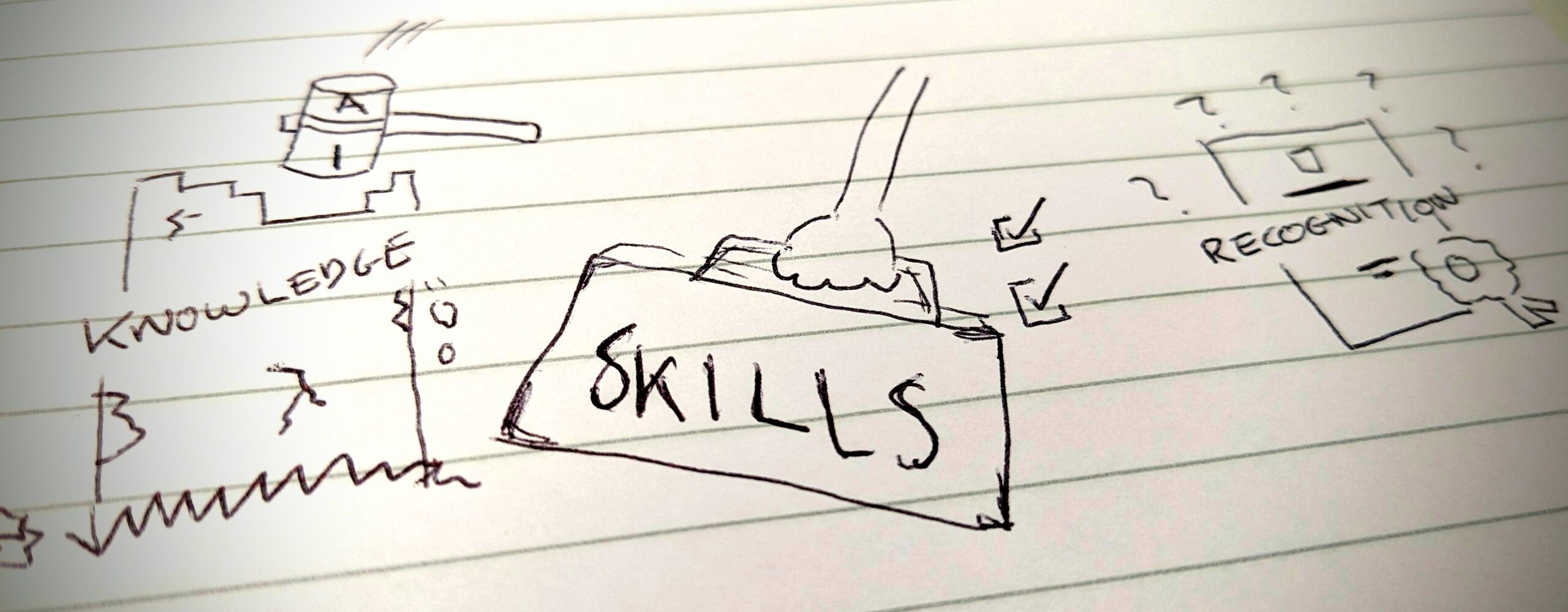
As an initial reflection on the first day of the Online Learning Summit 2025 at the University of Leeds, the notion of a skills-centred curriculum really comes out as an action to pursue to combat the existential threat some in the sector are perceiving. Professor Martin Bean articulated the imperative to make degrees relevant for the workplace, with a skills-first mindset, and develop students’ capabilities to be lifelong learners. His point is on the need to focus on “enduring human capabilities” to navigate a rapidly changing future, particularly as AI and generative-AI impacts the entire socio-economic balance of human employment. Taking this idea one stage further, it’s not just skills-first in education, but a skills-first ecosystem of education, employment and professional learning.
“When truth is being assailed, when citizens are trapped in bubbles, we have a problem. The only solution is education.”
Prof. Martin Bean, Online Learning Summit 2025
Bean challenges the inward-looking of the higher education sector, with league tables and statistics that measure institution against institution. Instead, he surfaces the reality of the full opportunity available to both young people as school leavers and professionals looking to switch careers through open learning, short courses and big tech corporations offering current, technical, skills-based learning that’s more flexible, affordable and connected to employment (see Google Certs, Microsoft Credentials, etc). Bean made an astute point that a university graduate gets a certificate and transcript with a title and some numbers, but this doesn’t convey much about that individual’s learning. We need to enable our students to show their learning in ways that will be recognised by employers and to have the skills to explain the relevance of their learning. If students can’t convey the relevance of their studies, either through lack of skill to do so or inadequacy of the curriculum or learning programme, then institutions only have themselves to blame. Compare formal educational qualifications to a professional certification that shows the skills and abilities learnt, ideally through direct application in the work place, and it reinforces the challenges that the higher education sector needs to address.
Higher education institutions will either try to compete in the same space as Google, Microsoft and the like (and I think lose) or need to integrate all forms of learning. This can be done by including professional certifications as accreditation of prior learning within programmes, or more broadly institutions and academics playing the role of education curator. Higher education has so much expertise in very specific subject disciplines, so there is a space for expert signposting, scaffolding and breadth of learning. Bean suggested to “build elegant and unbiased pathways for recognition of professional learning”, and that sounds relevant to me.
A lingering message is how higher education needs to be more adaptive. It’s a mindset shift, so actually we need to speak about how educators and professionals working in higher education need to be more adaptive. It can be easy to think of such existential challenges as a sector issue to solve, but the only way change happens is through the actions of people. We have to own this uncertain time and we have to use all our skill and knowledge to navigate it.
Short post, open thinking are posts of ill-formed ideas and notes that I’ve not expanded into articles. They are shared here in case they stimulate comment or ideas elsewhere.
Leave a Reply