
There is an increase in demand for skills-based education, largely arising from the perceived impact of artificial intelligence (AI) on a wide range of professions, industries and job sectors. Formal education providers need to consider how this demand will influence and inform the future provision of educational programmes and the broader, lifelong learning offer. Impacts will include how institutions collaborate, enable greater transference of learning between institutions and inter-disciplinarity of learning. The learning of knowledge and skills is set within a employment context framed with recent assertions of an overqualified labour market (Pantea, 2025) and a transition to a “post-knowledge economy” (Xie & Avila, 2025).
This article provides a summary of a workshop, originally presented at the Association for Learning Technology Annual Conference 23-24 October 2025, which highlighted current reports on workplace learning needs and how the future of formal education institutions (such as universities, higher education, professional learning and other settings) would need to adapt to respond to these needs. The opening presentation also included a summary of a lifelong learning ecosystem. Delegates then responded to four scenarios to prompt thinking about institutional readiness for the future of education, and the role that digital education professionals could play. A re-recording of the opening presentation is available below, followed by a short narrative and outputs from the workshop.
Highlights from workplace learning reports
The LinkedIn Work Change Report foregrounded the consequence of AI in the workplace in a broad sense, but was specific in calling out ongoing learning as the key for employee success. This is unsurprising considering LinkedIn Learning’s operating model of short course provision, but it does assertively state that “static credentials and ‘one-and-done’ learning are becoming a thing of the past” (LinkedIn, 2025). When you combine this with the World Economic Forum Future of Jobs Report suggesting “39% of workers will have a skillset that is outdated or transformed over the next five years” (WEF, 2025), there is a clear message that formal programmes of study need to enable learners to be adaptable and agile to a whole range of as yet undefined careers.
An accompanying argument is that this adaptability required of individuals shifts the emphasis of study from knowledge, to development of skills. Indeed, the Kelly Global Re:Work report states “65% of global executives say their organizations are moving from degree requirements to skills-based hiring” (Kelly, 2025). This does not mean that degree programmes are not required, far from it, as programmes of study provide a progression of knowledge and skills over an extended period of time. They provide a framework and scaffold for learning to take place within, broaden perspectives and introduce learners to concepts they would not otherwise have sought to explore. However, there is a difference proposed in the curriculum and educational experience design from ‘knowledge first’ to, as Martin Bean (2025) describes, “skills first”.
Before the emergence of AI impacting careers, it was already acknowledged that many formal education graduates would need to shift their careers through their life. The Deloitte Centre for the Edge report framed “enduring human capabilities” as the qualities individuals needed to respond to ever changing workplaces, adjusting knowledge and skills expectations, including: “curiosity, imagination, creativity, empathy and resilience… [that] can be cultivated through use and deliberate or inadvertent experiences and exposure” (Hagel et al., 2019). It’s the last part of this quote that is particularly important to note, in that ‘deliberate experiences and exposure’ is exactly where programmes of study have a key role, including learning design and digital education specialists to create appropriate learning spaces. The World Economic Forum expands on the skills-first idea, stating that the most sought after skills are: “analytical thinking… resilience, flexibility, agility… leadership, social influence” (WEF, 2025). These, in particular analytical and critical thinking, are the purview of many degree programmes, with resilience and social skills developed through project and group working.
Most recently, the UK Government released their Post-16 Education and Skills white paper. UK Governments have produced many such papers over the last 20 years, but there is a clear shift in language from meeting employers’ needs to now developing a more sophisticated ecosystem, a skills system that’s designed for people to adapt to what is changing in employment, workforce needs and industry. Of note also is the direct connection of higher education and skills in today’s policy direction, which was somewhat absent in the skills strategy of 20 years ago.
“Our ambition is to ensure that employers have the right skills to support the success of their business and organisations, and individuals have the skills they need to be both employable and personally fulfilled. We must put employers’ needs for skills on the stage. We must raise ambition in the demand for skills. We must motivate and support many more learners to re-engage in learning. We must make colleges and training providers more responses to employer’s and learners’ needs…”
Forward to the Skills Strategy (UK Government, 2003).
“We need a skills system that supports young people, employers, workers, and job searchers to navigate the changes in the job market, giving people the skills they need to adapt to the digital age and equip the whole workforce, old and young for the future – including people who wish to retrain or have taken a career break.”
Forward to the Post-16 Education and Skills White Paper (UK Government, 2025).
If we have a skills system that is designed for a broader range of learners, not just young people, but those changing career, those seeking work and those who have career breaks, then formal education itself has to become far more adaptable to the learners it intends to support.
Creating the educational ecosystem for lifelong learning
A previous post on education portfolio design articulated how a spectrum of learning experiences and course types can support a range of learning needs, appropriate to an individual’s point in their learning journey (Cornock, 2023). Recent examples of such a range of courses include: LSE Certificate of Professional Advancement, recognition for any 3 courses over 2 years; Coursera Professional Certificates of over 200 courses including Google, Microsoft, IBM, Meta, AWS reflecting industry needs; Deakin University, leading stackable short courses into postgraduate programmes.
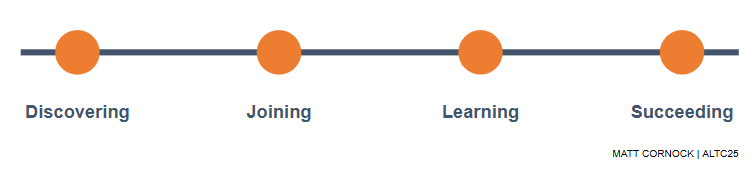
To respond to unknown career trajectories, to enable flexible, skills-based education, and to develop educational portfolios that meet a range of immediate and long-term needs, institutions need an ecosystem for lifelong learning. This requires a shift of perspective from educational programmes defined by institutions, to lifelong learning journeys defined by the learner. The ecosystem has to tap into each stage of the learning journey, but also enable learners to on-board and off-board as appropriate for their needs. From discovery of courses, through to enrollment processes that are scaleable and proportional, to the designed learning experience, and then beyond to how that learning is transferred into workplaces and successful individual practice.
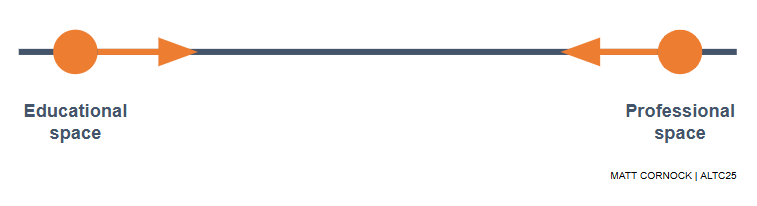
In purposeful learning design, both the educational spaces and the professional spaces need to be connected. They cannot be isolated and the links between those spaces at every stage in that ecosystem and in every stage of an individual’s learning journey need to be actively managed. This starts at learning needs and course discovery, but is equally important when considering how formal education and employer support is garnered, through to the practical application of learning during learning activities and assessment.
The role of digital education professionals
To develop a new educational future requires a range of expertise both from within and beyond institutions. To start with, considering the role that learning technologists, educational developers and learning designers play currently in curriculum and course design, there are four areas that such professionals can really inform practice.
- Digital capabilities and digital confidence.
- Platforms and integrated learning spaces providing the architecture for educational experiences.
- Inclusive design and digital accessibility.
- Curriculum design and activity design in collaboration with subject matter expertise and academic teams.
Digital education professionals need to ensure they are both informing and are informed by conversations in these areas. These types of institutional conversations are where professional experience and expertise should influence and through leadership by professional practice, enable institutions to put into action the future of education. This view adopts Leimeister’s (2010) notion of ‘collective intelligence’, in that a combination of perspectives are brought together with the thinking to tackle agile and adaptive challenges.
Collective “… group of individuals who are not required to have the same attitudes or viewpoints. Different members can reveal different perspectives and approaches, and thus leading to better explanations or solutions to a given problem.”
Intelligence “… the ability to learn, to understand, and to adapt to an environment by using own knowledge. This enables people to deal with changing and difficult situations.”
(Leimeister, 2010)
Scenarios for the future of education
This section reports on the outputs from workshop delegate responses to four scenarios as prompts to consider how institutions can involved a range of colleagues to prepare and lead on the future of education. The delegates represented a range of different viewpoints, with different perspectives and experiences to support better explanations and solutions to problems. The discussions surfaced expected challenges, unknowns and opportunities arising from each scenario. Delegates could opt into crediting their responses (included below).
The four scenarios are grounded in actual activity and steps being taken in higher education and professional learning sectors. The discussion prompts were:
- What are the questions/challenges posed?
- What expertise will you bring to the discussion?
- What expertise needs to be brought into the room?
The scenarios were:
- The ‘Inter-Institutional Student’ Scenario: Your institution is going to collaborate with two other institutions to offer an interdisciplinary programme drawing on the specialist subjects of each institution.
- The ‘Unbundled’ Scenario: Your institution is going to make all modules from all programmes of study available for anyone worldwide to join as a short course.
- The ‘Industry Partnership’ Scenario: Your institution is going to co-design a new set of skills-based courses with industry partners. Industry professional will be involved in the design, development, teaching and assessment throughout.
- The ‘Skills Wallet’ Scenario: Your institution is going to provide a skills wallet to enable students to demonstrate their learning and skills from both formal study and other activities to remain with them for life.
Inter-institutional student
Challenges
- UK HE is set up as a competitive market place.
- There are power dynamics in the relationships between institutions.
- Policies, systems, data sharing vary across institutions.
Opportunity to learn from cross-sector organisations who have developed joint approaches, and from research collaborations between institutions and industry.
Credit: Wilkinson, Sampson, Le Jeune, Hall, Clay.
Challenges
- Governance structures, both in terms of initial approvals and ongoing application of institutional rules.
- How to define a flexible and accessible programme of study.
- Where the location of learning will be, e.g. any campus-based provision.
Opportunity to bring in learning design, technological support, inclusivity and accessibility, finance, project management, marketing, student voice.
Unbundled
Challenges
- How to structure the programmes of study, for example carousel, teaching all year round.
- Practical aspects of platforms, registration, minimum student numbers.
- Need to learn from evaluation.
- Relationship management.
Industry partnership
Challenges
- Aligning the type of partner, balance of the partnership, oversight and governance.
- Aligning skills required (regulatory or desired skills).
- Technology and policy barriers (some sectors are highly regulated and have high levels of security which prohibit sharing of information).
Skills wallet
Challenges
- Defining skills (including an understanding of risks), relevant, local context of skills, portable, international and intercultural contexts.
- Need to develop students ability to present own skills and explain how they are relevant to where they want to get to; help students tell their own story.
- Critical appraisal of the rationale for skills wallets, enabling engagement with the initiative by focusing on the human, not the technology.
- Technology and governance framework, including progression.
- Need to agree on what the skills are, alignment to courses, measurement of the development of a skill.
- Longevity, how to keep it for life, any expiry date to skills; progression at different levels in employment; buy in from educational staff.
Opportunity to develop an understanding of non-traditional learning formats, including perspectives of organisations and realistic grounding of processes of learning and assessment.
Who needs to be in the room
Collated across all scenarios, the following provides a recommendation for stakeholder engagement, participation and pro-active contribution to addressing institutional readiness for the future of education.
- Student representation across diverse cohorts.
- Subject context through academic leadership.
- Connection between higher education and industry/professional sectors.
- Understanding of the career trajectories and journeys.
- Representation and leadership of inclusivity and accessibility.
- Operational matters, such as finance, systems management, project management and institutional governance.
- Marketing and input into how opportunities are framed appropriately.
- Ensuring a human-centered approach to the use of learning technology.
References
- Bean, M. (2025). Transforming Education: Seizing Opportunities in a Disrupted World. Online Learning Summit, University of Leeds, 10-11 July 2025.
- Cornock, M. (2023). Online education portfolio strategy and learning design.
- Hagel, J., Seely Brown, J. and Woolly, M. (2019). Skills change, but capabilities endure. Deloitte Centre for the Edge, Deloitte.
- HM Government (2003). 21st Century Skills Realising Our Potential: Individuals, Employers, Nation. CM 5810. London: TSO.
- HM Government (2025). Post-16 Education and Skills. CP 1412. London: HMSO.
- Kelly (2025). The Kelly Global Re:work Report: Workforce at a crossroads.
- Leimeister, J. M. (2010). ‘Collective intelligence’, Business & Information Systems Engineering, 4, pp.245-248.
- LinkedIn (2025). Work Change Report: AI is coming to work. January 2025.
- Pantea, M. (2025). ‘Degrees of Doubt: Overqualifcation as a Blind Spot at the Base of the Knowledge Economy’, Minerva.
- WEF (2025). The Future of Jobs Report 2025. World Economic Forum.
- Xie, Y. and Avila, S. (2025). ‘The social impact of generative LLM-based AI’, Chinese Journal of Sociology, 11(1).
Leave a Reply