
This is the second post writing up my experience at RIDE 2025, the Research in Distance Education and E-learning conference at the University of London (see Day 1 where I discuss themes of Context and Culture). Linda Amrane-Cooper, Director of the Centre for Online and Distance Education (CODE), introduced Day 2 with the rationale for why the word ‘distance’ is still used in the conference title, when most distance learning is now defined as ‘online education’. In summary, distance is more than the geographic distance, but also reflects the social, cultural and digital distances between institutions, educators and students. Therefore the conference sub-themes of inclusivity, well-being and belonging, and international education, explore how we as a sector are aiming to bridge multiple interpretations of distance. It perhaps is no surprise that my takeaway theme from this day relates to the distances travelled on learning journeys, unique to each student.
This post covers examples of excellent practices in accessibility, assessment and holistic views of online and digital education. One of the highlights of the day was the keynote discussion led by Ishan Kolhatkar, Global Client Evangelist at Inspera, on the provocative question of banning closed book examinations. This was such a valuable exploration of assessment that it deserves a separate post, but in the meantime my notes on that are available on LinkedIn.
Accessibility at scale
The thought of reviewing and updating 900 weeks of course content for modern accessibility standards is one that is both sobering, but also rather exciting. Bourgingnon presented the work at the University of Oxford’s Centre for Continuing Education to improve accessibility across their course portfolio. Underpinning the approach is a framework that brought together three intersecting perspectives from academic authors, learning designers and web developers to converge on the shared goal of the student learning experience. Accessibility is addressed at each stage of the design, development and teaching process. Accessibility adjustments such as portability of content, alternative formats and even quick wins such as changing ‘click here’ links to be more descriptive were clearly justified, not just because of the legal and moral imperative, but from student data. Whilst approximately 10% of students used assistive technology, 50% said they used subtitles on videos and 50% printed or downloaded offline copies of content. This quick survey showed how digital accessibility benefits a large proportion of students for a wide range of reasons.
Bourgingnon’s messages reflected on the culture of learning adopted in the team and in collaboration with academic colleagues. They have a “shared sense of accountability” and transparently and supportively find opportunities to improve. A key principle is that accessibility is embedded into the workflow, but crucially it is “never done”. This really taps into the balance course developers have to find between the time (and cost) to achieve the very highest standards, against the practicalities of implementing such standards within proprietary systems and the accessibility efforts that are going to be most impactful. Accepting that no course is perfect, that there is always room for improvement, is a fundamental part of online education practice.
Innovation and inclusion in assessment
In a very refreshing presentation that showed real innovation and care in creating inclusive assessment practices across multiple disciplines, Wood (University of Portsmouth) articulated that assessment choice matters as it enables “differentiated paths to the same learning outcome”, essentially, maximising the opportunity for all students to succeed, equitably. Underpinning this approach is intentional design for authentic assessment (Mueller, 2024), that focuses on ‘real-world’ skills and tasks.
Wood provided a number of case studies, including changing a fixed format of a written report to a report, video or viva; a two stage project proposal (written) into an initial 5 minute presentation and a longer presentation or slide deck; and student choice over the weighting of a multi-part, multi-format assessment. A safety net which took the higher score of the default weighting or student’s selection added to the care and thought of the implementation.
As well as giving greater ownership over assessment to students and being an inclusive approach to assessment, this allowed authentic skills development. Each case study showed how to embed more authentic deliverables that could be expected in the workplace and formats that developed a wider range of skills and approaches that would be required after study. Alongside, there needs to be recognition of the ‘hidden curriculum’ and appropriate scaffolding is needed to outline expectations of different formats, technical skills and structural cues, and suitable rubrics that are equitable across assessment types. This represents a skills and knowledge piece not just for students but for staff as well.
Widening perspectives and seeing connections
Last year I presented on systems thinking for digital accessibility and surfaced how the online education environment (content, activities, tools, people) are highly connected (Cornock, 2024). The holistic experience of online education requires multiple perspectives to see those connections, and in some cases surfacing unexpected relationships between decisions and impacts.
The interconnected nature of educational experiences was evidenced through three sessions this year, each demonstrating how widening the field of view helps bring greater understanding to the student experience. First, Akanbiemu highlighted the intersection of accessibility, inclusivity and digital literacy at the National Open University of Nigeria, home to 120,000 students. Extending the well versed TPACK framework (Mishra and Koehler, 2006), of technological pedagogic content knowledge, Akanbiemu brought in the human dimension shifting the focus from technology towards inclusion by applying a “Digital Equity Framework”. This involves not just considering how technology is used for learning, but how methods are inclusive and digitally accessible, and even as far as what policies support and advocate for digitally equitable experiences. I found this a useful argument for those working in digital and online education to not just focus on the design within programmes and courses, but the design within the context of the individual and institution.
One of the educational design decisions surfaced by Akanbiemu was the link between discussion forum participation and assessment. Students had to post once to gain access to the assessment submission. In isolation, initial posts were perfunctory, but over the course and with active educator facilitation, the discussions became more engaging and detailed. I found this observation interesting as it shows how behavioural influences (post before you can submit your assessment) are developed to influence learning through human intervention (educator engagement to help students get the most from the learning experience). Alongside this, there are also environmental factors such as the availability of internet connectivity, the demographic of students (71% aged 25-44 years old) typically with work and family commitments and, as highlighted through surveys, a gap in digital literacy which impacts confidence in independent online distance education.
Humanising engagement metrics
Secondly, Hoffman, et al. (Queen Mary, University of London) presented student perspectives on learning analytics used for engagement. Rather than focusing on the inputs of learning analytics, Hoffman suggested a focus on outcomes of engaged students, including academic outcomes, employment and confidence. Whilst the context for this study was campus lectures, there were useful parallels that could be drawn for fully online education. For example, administratively led decisions over timetabling can lead to large gaps between taught sessions, or a single session being scheduled on a specific day each week. This impacts student behaviour, where decisions over travel arrangements and cost come into play (particularly for students with family or work commitments, or those living at home away from campus), or where students feel their time is better spent in a different setting (at home, rather than studying on campus). Similarly, online students are juggling multiple priorities and may have preferred study environments (which may be at work or at home). Their engagement with online activities will be influenced by these external factors.
What I found fascinating was the student proposal for representing engagement. Whilst institutional views focus on attendance (whether that is clocking in to lectures or clicks in online learning environments), the students commented that they could be physically present, but that does not necessarily mean they are engaged. The design of the lecture, the topic and their state of mind means that attendance is not a proxy for engagement, as they could be doing anything in that space. The lecture experience can also be intimidating, not every student will want to raise their hand and ask for clarification in front of 300 peers. This observation encapsulates the human experience of scheduled teaching, rather than the administrative view. Their solution was to use formative assessment opportunities as the measure of engagement. Implied here is a much richer picture of engagement and indicator of outcomes than attendance.
Digital capability and digital confidence
The third session which highlighted the complexity and interconnectedness of educational environments was at the end of the day, led by Bancroft, et al. (Nottingham Trent University). Discussion started by exploring what it means to be a confident digital learner, with our table considering the interplay between attitudes (including willingness, risk appetite, problem-solving), technical competence, access (tools, appropriate learning spaces) and human interaction (approach to community and support).
“Digital confidence is distinct from digital competence… they develop at different rates… and it can be easy to make assumptions [about individuals or groups], but that might not be helpful from an equity perspective.”
(Bancroft, et al., 2025)
The connections that influence the success of digital learners surfaced further when we explored the question “When might our digital confidence get knocked and what might help us recover it?”. Our table captured a number of perspectives, once again demonstrating the influences and impacts in online learning environments (pictured below). We considered student support mechanisms, including through wider services such as IT, disability studies and academic teams, and how individual and institutional approaches to support are designed. There were factors applicable to both staff and students, such as the pace of change with AI, logging into synchronous spaces early to check connections, and having time to develop confidence with a range of digital tools. Noting the range of backgrounds, demographics and levels of competence, it seemed important that processes and structures were in place to ‘meet people where they are’.
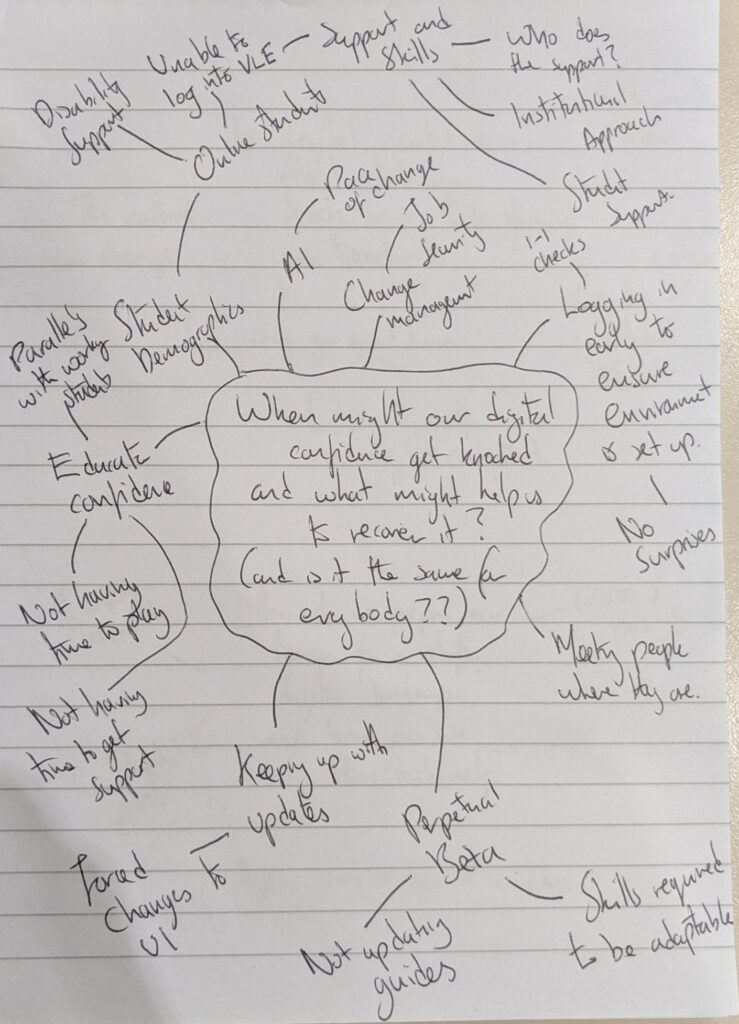
Following a contribution about keeping on top of software updates (MS Teams recent refresh cited as a prime example), I added ‘perpetual beta’, which is a term used to describe how software and apps are never in a final state, but new features are added (some work fully, some don’t) and the development of user experience is iterative. This phenomenon is one of the key reasons why creating technical ‘how-to’ guides is a losing battle and what is needed is a skills agenda, developing the digital capability and confidence to navigate shifting interfaces. In fact, this point chimes well with Bancroft, et al. who suggested that “digital confidence could support us in navigating change”, including changes more broadly than those in the digital space.
The journey students take
My concluding thoughts from this conference is a reminder about the journeys that students take in education. Each student comes from their own background, bringing their own knowledge and experiences into the designed educational experience. Through that experience their success is influenced by a wide range of factors, both intrinsic and extrinsic, and it is our role as shapers of the holistic educational system to ensure that all students have the best chance of success. It is through the journey and navigating distances that each student can progress with a unique set of outcomes.
References
Cornock, M. (2024). Applying systems thinking to digital accessibility and online education: a case study. In Hatzipanagos, S. & Pachler, N. (Eds.), Advances in Online and Distance Education: Selected Papers from the RIDE 2024 Conference (pp. 23-30). Centre for Online and Distance Education, University of London.
Mishra P. and Koehler M. J. (2006). Technological pedagogical content knowledge: A framework for teacher knowledge. Teachers College Record, 108(6), 1017–1054.
Mueller, J. (2024). Authentic assessment toolbox.
All sessions at RIDE 2025: Empowering and Sustaining Change, Research in Distance Education and E-learning Conference, Centre for Online and Distance Education, University of London, 14 March 2025.
Akanbiemu, A. (2025). Enhancing Digital Literacy and Accessibility for Inclusive Learning in Distance Education: A case of National Open University of Nigeria. (National Open University of Nigeria).
Bancroft, R., Challen, R., Pearce, R. and Witham, B. (2025). What does “digitally confident” look like? (Nottingham Trent University).
Bourguignon, J. (2025). Improving accessibility of online courses at scale: where do I start? (University of Oxford).
Hoffman, N. L., Elliott, J., Naeem, U. and Bouhedda, A. (2025). Student perspectives on engagement and using learning analytics to guide learning behaviours. (Queen Mary, University of London).
Wood, C. (2025). Inclusive Education through Alternative Summative Assessments: A Pilot Study. (University of Portsmouth).
Acknowledgement
My attendance at RIDE 2025 Conference was funded by the University of Leeds in my role as Head of Online Learning, Digital Education Service.
Leave a Reply