Online education brings together many people as educators, students and professionals. It’s a highly collaborative sector and it’s underpinned in many ways by a desire to do good. This year’s Research in Distance Education and E-learning conference at the University of London has the title ‘Empowering and Sustaining Change’ and in any change process the human element and underlying values play a critical part in the success. This summary of Day 1 covers some of the sessions which explored the significance of understanding the people within online education, the shared values and the context of learning. See also: Day 2 on the journeys taken.
Context and culture
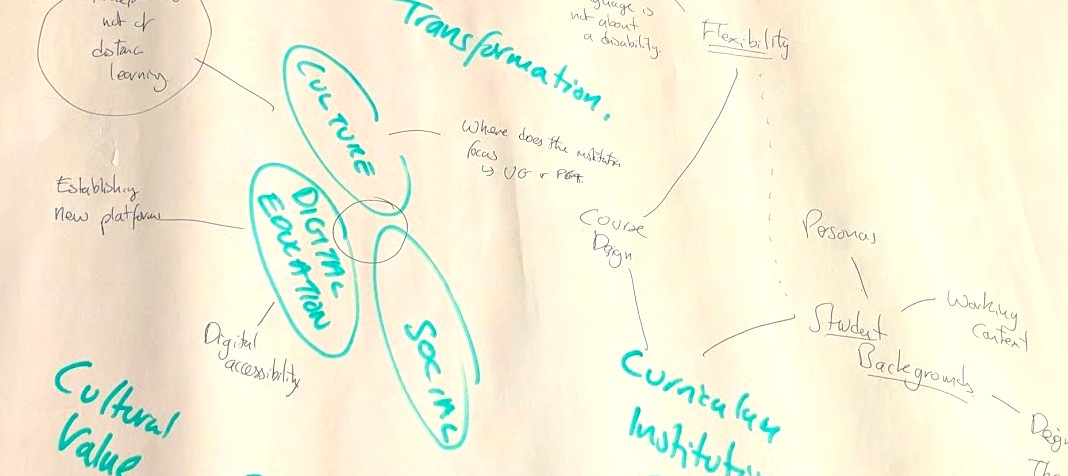
For me, there appeared to be two words that kept coming back to me during the day: context and culture. This may of course be influenced by the first session I attended on cultural and social dimensions in digital education (Rofe, et al.). Attygalle provided a summary of three themes from a literature review which offered prompts to consider how the social and cultural dimensions are reflected in educational structures: curriculum and institutional strategy, digital transformation, and cultural values and digital inclusion. This prompt led to consideration of how culture manifests at institutional, team and individual level, and how social interactions influence the implementation and success of digital strategy and practice.
Our table discussion showed the underlying values held by online and digital education teams, particularly with a focus on student experience, flexibility and accessibility. We noted similarities between our institutions on design-led approaches, having an understanding of the learner, using personas to avoid assumptions that all learners are the same. These values transcended continental borders, with participants from University of Lagos sharing how tablets are available to students and laptops with assistive technology installed help to address digital inclusion and accessibility barriers. What I found particularly meaningful was the way these approaches were described as for “equal opportunities”, rather than language of impairment or disability framed in a way that it was up to students to solve. This really showed the values of inclusion by creating clear institutional actions that stem from strong values about education.
My final reflection on this is whether we also need to consider extra-institutional culture, in terms of the acceptance in wider society of online, digital and distance education (three separate educational contexts). It raises the questions of how we as educational professionals respond to and influence digital transformation in society, digital inclusion and learner expectations of a full range of educational experiences.
Designing for context
Patel, et al. presented on the use of peer review activities and assessments in open courses, with a valuable critique of the effectiveness of these tasks within the online context. This is in direct contrast to how heavily scaffolded and embedded peer assessment in formal (typically in person) education may be seen as exemplary practice. In the open course context, only 6%-10% of learners engaged in peer review exercises. Further, Patel, et al. noted the risks of highly polarised marking approaches where learner peer assessors were not fully engaging with the rubric, such as an assessment both being graded as poor and good by different markers. Where AI marking was available, 77% of submissions were responded to without human intervention. Whilst this afforded rapid responses to submissions, particularly useful in highly asynchronous open courses, what concerned me was that the full experience and learning opportunity of peer assessment wasn’t utilised by learners. Part of the value of peer review is to engage with marking criteria and to critically appraise submissions, thinking not just about feedback to give, but also comparing others’ work to your own and gaining alternative insights to assessment questions. Learners were likely to have limited trust in rubric that offered conflicting feedback and, arguably, gained limited learning value if they did not fully engage in the peer review process. This presentation showed that design and scaffolding is critical to the success of peer review.
“Peer review can enhance online learning, provided it is… scaffolded into course design and supported with detailed instruction on use and purpose.”
(Patel, et al., 2025)
Presenting a transnational education (TNE) teacher development programme, Kay and Kwihangana from King’s College London shared a sample of the embedded approaches in their courses which demonstrate to their students effective teaching practices. These included: the use of multiple-choice quizzes as scenario questions, rather than recall, where the automated feedback provided rich explanations of preferred responses; the use of welcome videos to provide educator presence; and co-developed learning community agreements between both educator and student to encourage active participation by both. Kwihangana made an excellent point that students take courses because they want to do something with what they have learnt, “it’s not about content, but about context.” In this way, courses need to be designed to enable learners, each with their own context, to take their learning and apply within their own situation. This is all the more important in TNE where learners will have a wide range of backgrounds, constraints and unknowns, requiring responsive education and adaptability. Learning design is highly evident here with a conscious choice over the sequence of activities and embedding of reflective practice for both the educator and learner.
Design cultures
The significance of design processes also came through Freire’s session on the programme development approach at Queen Mary, University of London. Similar to the approach we adopt at the University of Leeds, the programme design phase brings together colleagues across specialist teams to work collaboratively with academic teams and shape the design for the programme process. At Leeds, learning designers are involved right from proposal stage and look at outcomes, content, assessment and skills across the programme, considering the affordances and opportunities that online and digital education approaches offer a specific discipline. Freire noted how existing approaches to education, influenced by the values and skills educators may have in teaching, need collaboration with digital education specialists in order to apply these to the online and digital context. This is crucial to avoid attempts at replicating campus-based educational approaches in a difference space, with different learners and different interactions. Echoing my own views on what ‘good’ online education should be, Freire talked of ‘relational’ rather than ‘transactional’ education, which applies as equally to the design and development process between digital education professionals and academic teams, as it does the teaching.
“Build the tech for the joy and flow we want to achieve.”
(Freire, 2025)
The role of learning technologists is key in the Queen Mary model, complementing ‘off the shelf’ environments with the skill and knowledge that allows for bespoke development to make online education possible in subjects that may require thinking outside of the box. I noted also three very clear values on Freire’s slide template that indicate the culture of the Digital Education team: care, disrupt, empower. They are highly active verbs, grounded in the humanity of education.
Culture of community
Wrapping up the day, I attended a workshop on reading groups (Armstrong), as a way of building and sustaining a digital education community. In true form, the table discussion veered a little away from the prescribed prompts, but raised a number of points about developing communities of practice. Overcoming systematic challenges, such as imposed logging of CPD time and booking onto such sessions were key practical issues that needed to be addressed in some institutions. This type of barrier sets a cultural precedent that engaging in communities of practice is something that needs to be approved, rather than something that is part of being a professional in education.
There were some excellent suggestions on inclusivity and flexibility, such as an open door on whether individuals have prepared or not for discussions, the use of Gen-AI tools to summarise lengthy documents, the use of accessibility tools to create audio alternatives and including blogs and videos as source material rather than exclusively academic papers. Ownership of the group has to sit with the individuals, rather than a chair (lending itself to be a committee) or overpowered by dominant voices. This shared safe space is something worth exploring in terms of the typically hierarchical culture of educational institutions and how we can encourage all colleagues to contribute to the discourse and development of practice in online and digital education.
References
All sessions at RIDE 2025: Empowering and Sustaining Change, Research in Distance Education Conference, Centre for Online and Distance Education, University of London, 13 March 2025.
Armstrong, A. (2025). Connecting practitioners: how to cultivate a digital education community with a reading group. (University of London).
Freire, J. (2025). Fostering inclusive and active learning through co-creation: breaking silos with a multidisciplinary online programme development approach. (Queen Mary, University of London).
Kay, M. and Kwihangana, F. (2025). Designing transnational online courses for African learners: collaboration, prototyping and evaluation. (King’s College London).
Patel, D., Grice, L, Deenadayaal, A. and Imran, S. (2025). Evaluating peer review practices in online degree moules and MOOCs. (University of London).
Rofe, J. S., Korosec, M., Attygalle, S., Gretton, N. and Adachi, C. (2025). Let’s discuss: Cultural and Social Dimensions in Digital Education. (CODE Fellows).
Acknowledgement
My attendance at RIDE 2025 Conference was funded by the University of Leeds in my role as Head of Online Learning, Digital Education Service.
Leave a Reply